

Before you begin
An imported or authored screenplay with its Cast Members. Ask the agent to develop missing Cast Members before analyzing their arcs. Big Fish is the example; your own screenplay works the same way.
What you’ll do
A reviewed reading of the main characters’ dramatic journeys, with turning points grounded in their scenes.
Start with screenplay analysis
Screenplay Analyst creates the screenplay’s three-act critique and Character Arcs in the same analysis request. By default, arcs cover protagonists and key supporting roles whose inner journey the story follows. Minor, background, and ensemble roles do not all need an arc.
- Ask the agent to analyze your screenplay. You do not need a separate arc request for the main characters.
- Read the overall critique under Analysis > Screenplay Analysis. Then open Cast > Edward Bloom > Arc, or the equivalent main character in your project.
- If you want an arc for an additional character, ask explicitly. If a character’s Arc tab is empty, first consider whether they fall outside the main roles covered by the standard analysis.
Analyze my screenplay.
Read the arc as an interpretation
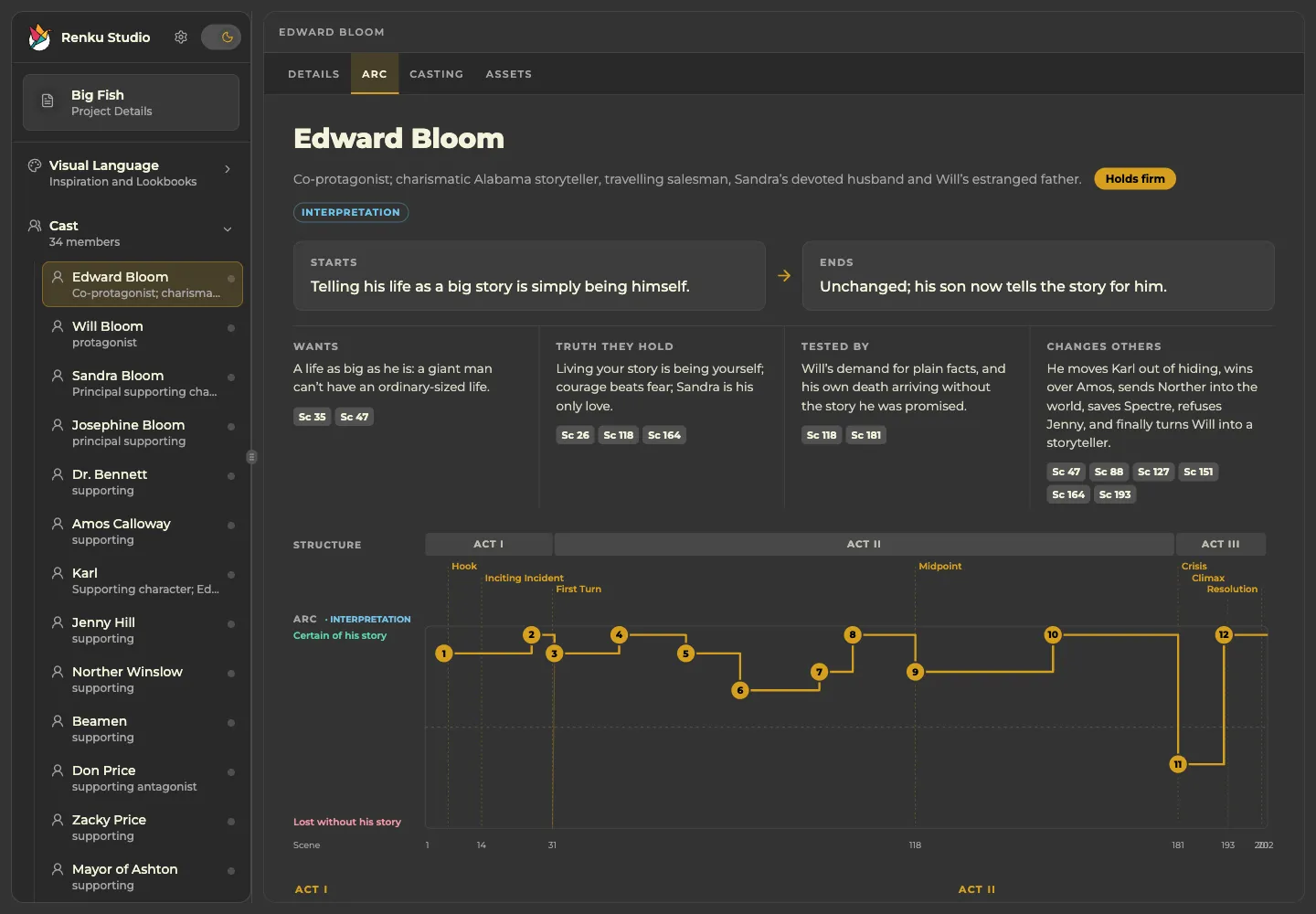
The Arc tab describes where the character starts and ends, what they want, and what drives or tests them. Its Interpretation label matters: this is an evidence-backed reading you can question and refine. A character can grow, hold firm, become disillusioned, fall, or become corrupted.
- Start with the arc type and the start and end states. Edward’s saved reading is Holds firm: his commitment to storytelling persists while Will’s relationship to those stories changes.
- Read the motivations beneath them. A changing character has an inner need and false belief; a Holds firm character instead shows the truth they hold, what tests it, and how they change others.
- Read the chart’s two named ends before interpreting its rises and falls. Edward’s are certainty in his story and being lost without it. The line follows that interpretation, rather than a generic measure of happiness or a quality score.
- Compare the turning points against the screenplay’s act structure and key story beats shown above the line. They describe the character’s journey through the same scenes.
Check the moments behind the line
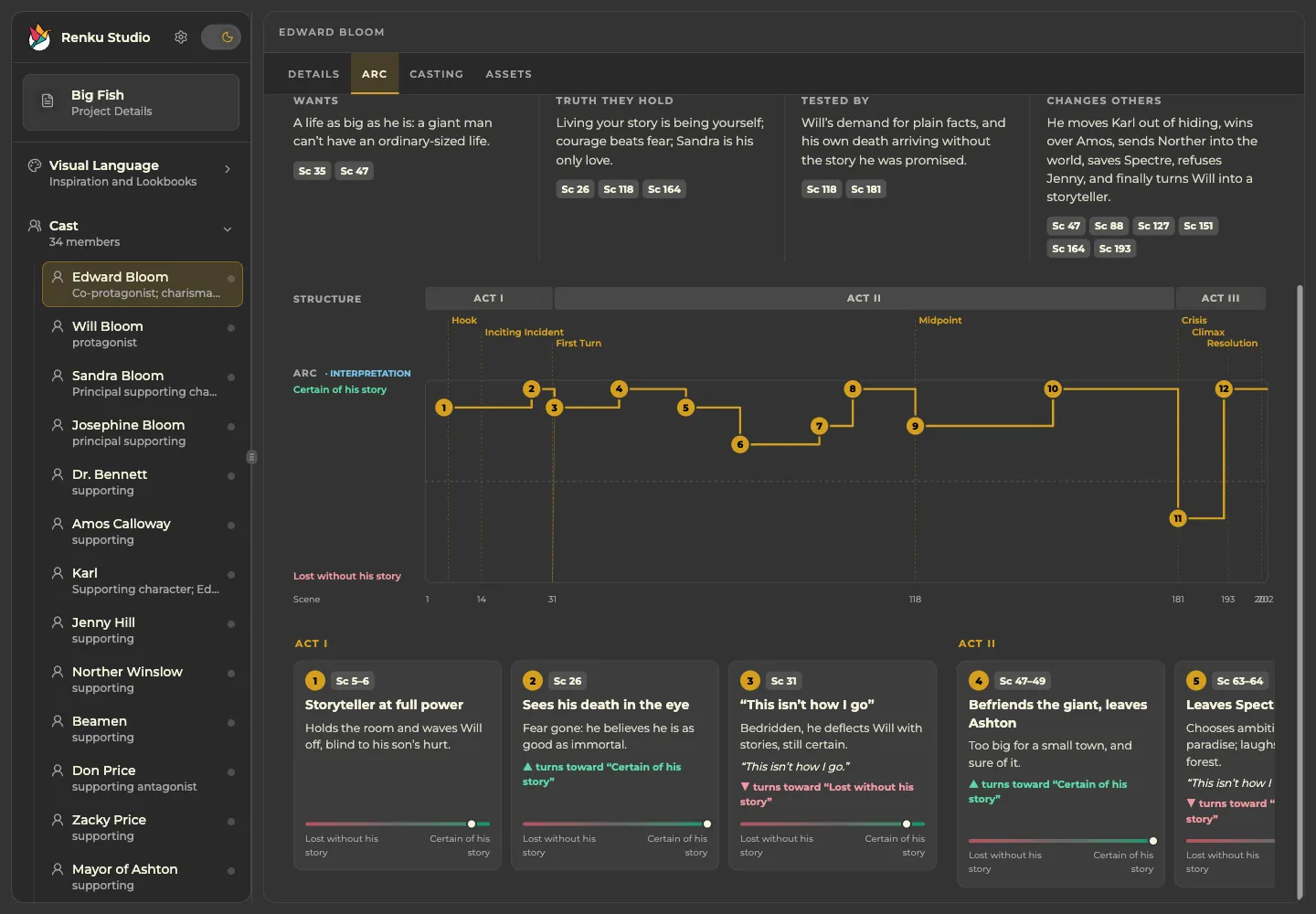
Below the timeline, numbered turning-point cards explain the character’s state at specific scenes, grouped by act. Scene references and any quoted dialogue let you check whether the interpretation is supported by what the screenplay actually shows.
- Scroll down to the cards and across the row to follow the turning points. Match their numbers to the chart.
- For Edward, compare his assurance while befriending Karl with his uncertainty near the end and the resolution through Will. A Holds firm arc can still contain fear, setbacks, and emotional movement.
- Challenge a reading with a scene or passage. Ask for a focused revision when the arc type, motivation, or a turning point misses your intent. Analysis suggests changes; it does not rewrite the screenplay.
- A new full screenplay analysis also rewrites the main characters’ arcs. Review those refreshed readings after substantial script changes.
Review Edward Bloom’s arc. Explain the scene evidence for reading him as Holds firm, especially how his relationship with Will tests him.
One life, one arc, several Looks
Young and older Edward belong to one Cast Member and one Character Arc across the whole screenplay. Their visible ages can have separate Looks for casting. Looks answer how the person appears in each scene; the arc follows their dramatic journey.
- Keep the person together even when the script uses age-specific character cues.
- Use Looks for age or major physique differences, as with Karl’s giant and real-world appearances. Keep costumes within the relevant Look.
- Use the arc as performance context when developing designs, Beats, or coverage. Ask the agent to draw on it when a scene’s emotional direction needs attention.
Before you finish
The main characters’ arcs are saved, their motivations and turning points are supported by the screenplay, and you understand which readings you want to keep or revise. Different ages of one person remain part of the same arc.